Showing posts with label Full Book Blogs. Show all posts

Tuesday, April 26, 2011

Living With Complexity

Living With Complexity
Don A. Norman
Source
Summary:
Chapter 1: In the first chapter of this book, Norman differentiates between complexity and complicated. Something that is complex is described as a state of mind, however something that is understandable, just maybe difficult to master. Something that is complicated is something that is confusing, difficult to understand. Norman claims that complex things can be enjoyable and desirable. When things are too simple, they may appear as boring. 

Chapter 2: Norman discusses the idea that simplicity is in the mind of each individual. Depending on the scenario and the situation the individual is, that is the level of complexity that he will give to a certain task. Norman again discusses Conceptual Models, and how they are created either simple or complex depending on the individual. Norman also demonstrates that not even the things we believe the most simple, are in fact simple. Each artifact should have an appropriate level of complexity. Norman also reaches to the conclusion that individuals prefer an intermediate level of complexity. As previously states, individuals may find simple stuff to be boring and unworthy.

Chapter 3: Norman discusses how things that are supposed to be simple and non trivial can in fact complicate our lives. He gives the examples of door locks and passwords to demonstrate this idea. If we had only one door knob or only one password, then that would be an easy task to remember, however, technology allows for more than one door knob and requires more than one password. This idea then leads us to put information in the world, making it easier to be accessed by undesired people. Norman claims the solution to these problems is in the quality of a design.

Chapter 4: Social signifiers are those indicators that are either deliberately or incidentally placed that provide information to an individual. Signifiers are similar to affordances, in fact they are the perceived affordances. Norman discusses how culture affects these signifiers and how effective they really are.

Discussion: One of the main topics so far in the book is the idea that we should be able to differentiate between something that is complex from something that is confusing. The fact that certain device looks simple, does not necessarily mean it is better, in fact in many of the cases means that the device is even more complicated than it really looks like. 
 
When reading about this, it reminded me about the example Norman gave in one of his previous readings, and how we may think that a phone with less buttons is simpler, however, the telephone does not provide enough information to create an appropriate mental model.
 
Something I did enjoy reading about in these chapters was about the irony technology is what some times introduces complexity, however technology is also able to automate or somehow deal with this high complexity.
 
Even though the ideas are interesting, these were previously introduced by the other Norman books, so it is not something new really. As in the previous readings, Norman examples are useful and applicable to life, which in my opinion makes the book more readable. 

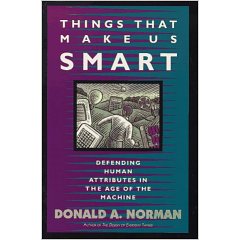
Now that I look back after reading the first chapters of the book, I can now understand the meaning of its cover page. How something that should be really simple, such as salt and pepper containers, can actually complicate our lives if they are not well designed and maybe even standardized.

Thursday, April 21, 2011

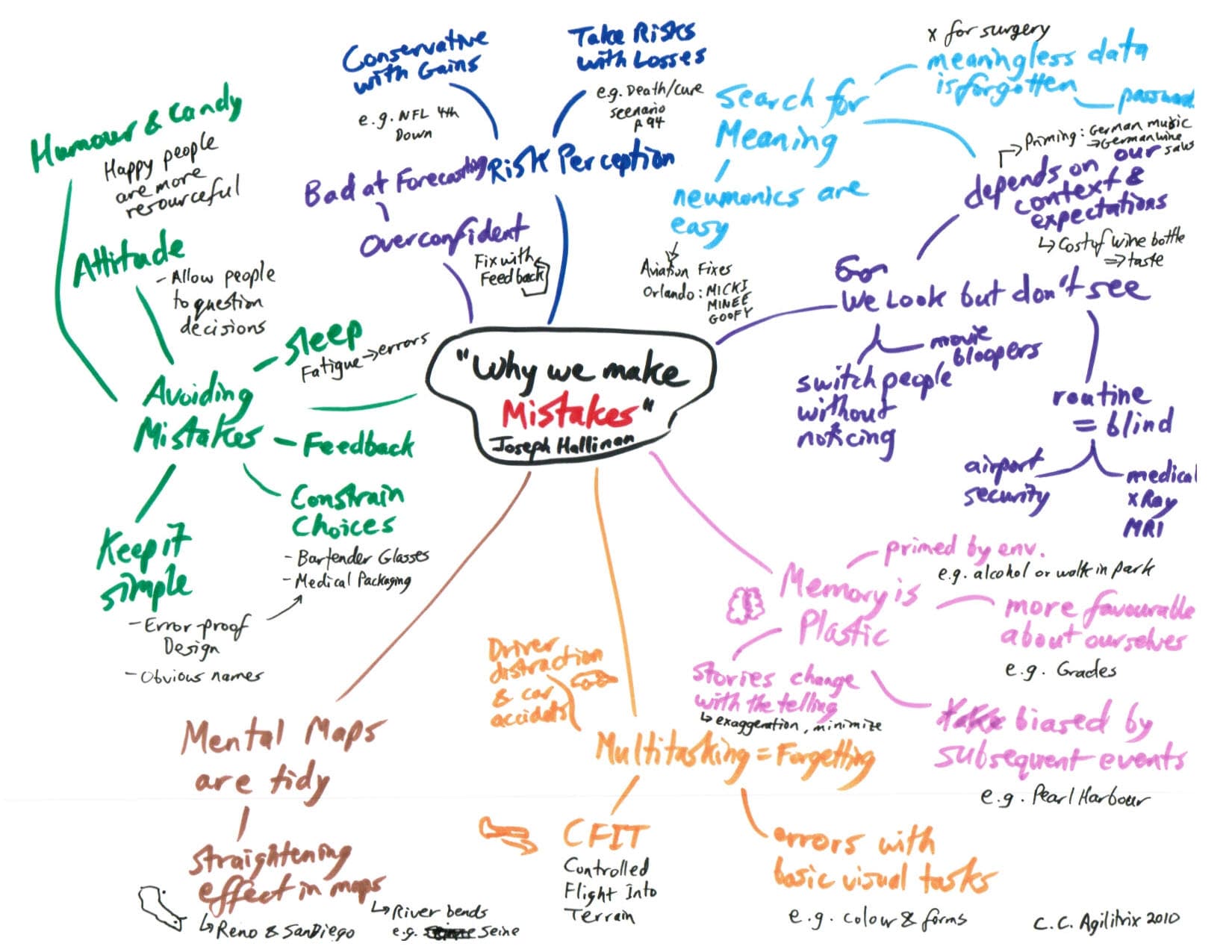
Why We Make Mistakes

Why We Make Mistakes
Joseph T. Hallinan

Summary:
Chapter 0:In this introduction to the book, Hallinan discusses how frequent mistakes are done. He claims people more than often attribute the fault of a mistake to the person who committed the mistake, instead of anything else (the car example). We are willing to take the bad of things in order to get the good part of it, and world we live in is not helping us. Hallinan claims that being aware of our acts should help us decrease our mistakes (the multiple item sale).

Chapter 1: Not being able to see (observe and catch details) of things in front of us is a cause of mistakes. We only see a fraction of what we think we are seeing, our focus is in only one thing, and what is in the background is very blurry. We notice on a Need-to-Know Basis, noticing only things that are important or relevant to us, and ignoring the rest. 

Chapter 2:  We are able to better remember things when they have a meaning to us, than meaningless things. For example remembering the features of a penny, remembering faces better than names, being able to remember random things by giving them some kind of meaning, and how we can mistakenly recognize a face by things that are not enough and easily confused.

Chapter 3:  Individuals make choices based on "invisible" factors. For example making judgments of people based on pictures only, how a woman's physiology affects men reactions, and how students feel about chaining answers in tests (something contrary to what researchers have discovered). 

Chapter 4: The overall idea of this chapter was about the tendency to see and remember things in a way that is "self-serving," it makes us look better. Creeping determinism: suppressing some facts at the expense of others. Also, knowing the outcome of events affects the way we remember past events, say predictions (hindsight bias). Stereotypes and conflict of interests also lead to misremembered events. Trying to disclose a bias does not cancel the bias, it even increases it ("Hey I warned you" Principle).

Chapter 5:  It is not possible to divide our attention into more than one event (multitasking), we can only jump back and forth. Inattentional blindness as a condition where a person is looking directly at something but is not really seeing it.

Chapter 6: We-re in the Wong Frame of Mind. The framing of mind (looking at an issue in the wrong way) is influenced by the environment (French v. German music example),  by the risk involved in decision making (NFL example), by time and events (9/11 example). Studies show that when people are asked to decide over an issue, they will "anchor" they responses to a number, especially if it's the first one they are given (the grocery store prices example).

Chapter 7: We Skim. People will learn how to skim through text, music notes, and even images. Once the person is so familiar with what they are seeing, they will tend to not focus completely on it, thus only skimming through the piece of information.Also, when context is missing, or a situation is set in a unique context, the outcomes of the observed situation are different.

Chapter 8: People like to straighten things up, make them simple or even rationalize them in order to understand them better. Some of the examples given include those of straightening streets in New York, the Seine river in Paris; simplifying or shortening maps, stories that we re-tell and even the national anthem. We don't do it in purpose, in fact we truly believe what we do.

Chapter 9: Men and women behave differently, and in majority of the cases, men tend to do better than women. Men are overconfident, and this overconfidence is then transformed into taking risks for example; men are more likely to take risks than women. One of the roots of this difference is attributed to the early years of men and women; men are given more freedom to 'tinker' (explore) around than women.

Chapter 10:  Overconfidence is one of the main reasons why people believe they are better at something than they really are. It is observed in almost everyone, except those who are depressed. Businesses have learned how to take advantages of this overconfidence, and individuals end up loosing money thinking they will do better than others, for example going more often to the gym, paying off credit cards before interest rates get higher, and thinking we can diet better than the average person. The term for this concept is calibration, we are poorly calibrated thinking we are better than we in fact are. We think that the more information we obtain the better equipped we will be, which actually leads to information overflow.

Chapter 11: We'd Rather Wing It. Practice is what makes experts. Almost 10 years of serious practice are required for someone to become an expert at something. This fact is attributed to experts practicing creating a library in their minds, where they use patter recognition to allow them to anticipate evens and learn how to respond quickly. Cognitive maps are what people and how non experts rather try doing things themselves without reading manual, just guided by how they think work, but unfortunately this leads them to make many errors.People become accustomed to a way of doing things, that they ignore new and simpler ways to getting things done.

Chapter 12:  Employing constraints and affordances could avoid many of the "human errors" we make. Some of the examples given include the deaths of many patients when given the wrong prescription or the wrong amount of doses. How these errors could be avoided if we give meaningful names and descriptions to things, such as the names of the points in the sky given by the FAA. Misattributing the error to the correct reason is one of the reasons why we haven't been able to prevent us from making so many errors. FAA has taken in order to reduce the amount of human error, something medical societies have not. 

Chapter 13: Individuals are not very accurate at predicting how happy they and other will feel as a consequence of an event. For example moving to California, and how everybody thinks they will be happier if they lived there, but in fact, there are many people who decide to move from there after trying to live there for a couple of years. One of the causes is that of having hope that things becoming better. If there is hope that a situation can become better, individuals are not adapting to the current situation, thus not living it to the best of their abilities.

Conclusion.  Hallinan recommends that we give close attention to those things we have opted not to choose, this is a good exercise to realize the why of our mistakes and we can learn from them. He also invites the readers to think a bit negatively sometimes, not always positive. To allow ourselves to learn even from those who are not such experts as we think, since their non-expertize will allow them to see errors that the experts have overlooked. He also recommends people to sleep well, since he claims that sleepiness is one of the main causes of error. And to be happy with what we have, learn how to love what we currently have because if we keep thinking about what we could have we will be unhappy.
Source

Discussion: This book discusses ideas that were introduced in the Norman books, such as claiming that the world we are living in is pushing us to make mistakes for example when we have to learn so many PINs and passwords. He also claims we can only remember a few things at a time, just like Norman explained. The concepts of constraints and affordances are later discussed in this chapter, and it was surprising to see the similarities in the explanations about these concepts from both Hallinan and Norman.  

Hallinan provides concepts and factors that affect individual's choices, factors that we cannot see. For example the meaning we give to things is one of the most efficient things to remember them. Also, he explains how things that we do or believe unconsciously, affect our acts. idents was really interesting. The fact that it is intended to do good but ends up doing the opposite can take us back to design concepts. He even mentioned some things that could be done to the design in order to decrease distraction, but the problem is that these should be there since the beginning in order to avoid these horrible deadly accidents.

It was interesting to read about examples that one way or another I have thought about before and now, I can read about the logic or explanations behind them, and why we behave as we do. It is also interesting to see how majority of these scenarios have been researched and experiments have been performed in similar situations.

One of the discussions that most called my attention and that was somehow linking a few of the chapters was overconfidence. It's amazing how being overconfident can be both, good and bad, depending on the situation you are in.

Thursday, April 7, 2011

Things That Make Us Smart

Things That Make Us Smart
Donald. A. Norman

Summary:
Chapter 1: A Human-Centered Technology. Norman opens the chapter by stating that technology not only has positive effects, but negatives as well. The main idea of this first chapter is that technology has been developed with a focus apart from humans. It has not been design to accommodate humans, but humans must adapt to technology. He also introduces the two types of cognition relevant to his studies, experiential and reflective.

Chapter 2: Experiencing the World. In this chapter, Norman goes more in depth in describing experiential and reflective cognition. In summary, they differ in the way information is processed. Norman describes the experiential mode as of data-driven processing. It is automatic, it is our reactions to events. The reflective mode in the other hand is the one concerning concepts, planning and evaluation. He also describes three kinds of learning: accretion (accumulation of facts). tuning (practice to become experts), and  restructuring (not losing practice).
 
Chapter 3: The Power of Representation. In this chapter Norm talks about how we represent the world utilizing cognitive artifacts. He defines the Represented World (Real World), and the Representing World (symbols which represent the represented world). He also discuses various ways in which data can be represented, and explains how some lead to experiential cognition while others to reflective cognition.
Chapter 4: Fitting the Artifact to the Person. Norman introduces the concepts of surface and internal representation. Surface representation is when what we see is all there is to it (a book), an internal representation has more in the background that we cannot see (calculator). He also discusses how representations must fit the task or the person, depending in the situation. He also brings back the concept of affordances in terms of technology. He claims technology also has affordances.
 
Discussion:  Overall I like the way Norman is presenting the concepts of the book, however I think the examples are too long. Even though the chapters are long, they are still interesting to read. I really enjoyed the first chapter since I think it deals more directly with CHI, and how our designs should be of positive results for users. On the third chapter, the discussion about representing numbers was really interesting. It made me remember my days of school when I had to learn Roman numerals. I think it is really interesting how each representation allows you to do different things easier than the others. For chapter four, the discussion about affordances in technology was the best part in my opinion. I like how Norman bring this concepts back from The Design of Every Day Things, and includes it in this chapter.

Sunday, April 3, 2011

Emotional Design

Emotional Design
Don A. Norman

Source
Summary: 
Chapter 1: Attractive Things Work Better. In this opening chapter, Norman exposes the idea that attractive things work better, like the title says. He claims when a device is aesthetically more attractive than another, but both share the same functionality, users will prefer to use and will rate higher the one that is more attractive. He also discusses the three level of processing: visceral, behavioral, and reflective.

Chapter 2: The Multiple Faces of Emotion and Design. Norman discusses how the three levels the cognitive and emotional system work together to provide the user an overall experience of the product. He also discusses objects that evoke memories and the effect they have for example souvenirs and photographs. The feelings that design, marketing, and the use of products bring to individuals and how they change the way we think of ourselves.

Chapter 3: Three Levels of Design: Visceral, Behavioral, and Reflective. Norman explores more in depth of what factors are considered and affect these three levels of design. Visceral design consists of emotions, appearance, and the first impression of an object. It is important because it hooks the user's attention, sometimes without knowing what the item really is or what it is for. Behavioral design is concerned with usability - basically the topic of The Design of Everyday Things. And finally, reflective design relates to our perspective to the product. How it affects our lives, culture and other factors may affect this level of design.

Discussion: I really enjoyed reading about aesthetic design from Norman's point of view, since in The Design of Everyday Things he completely ignored and even made it seem irrelevant compared to usability. I was curious about how this change came about, so I skimmed through the prologue and found that Norman states he has actually changed his mind and now understands how important the aesthetic part is.

Reflecting on the examples given by Norman, about the personality of items (video game consoles) and how the use of different things makes us feel (cake mix), and they are true. There are still many products that are designed and geared for only part of the population, but other people still use them. However, there are others that have changed. My computer is pink! Just like its cover, and my backpack! I usually don't like buying products marked with the "Just add water!" phrase because I think they are only for those who want to avoid the hazel of going through the process, and personally I don't think they taste the same way (I may be wrong).

It is a big change from the readings from The Design of Everyday Things, but at the same time Norman is integrating both sides of design, and understanding not only usability is important. "I want it, I don't know what it is, but I want it." I've heard this before, from me and from others... my little cousins and their toys, they don't even what the toy is for, but they want it. I do think that appearance is a major part of design that is how users' attention is called in the first place.

Sunday, March 27, 2011

Obedience to Authority

Obedience to Authority
Stanley Milgram

Summary:
Chapter 1: The Dilemma of Obedience. Chapter one serves as an introduction to the book. Milgram discusses obedience, describing it as a basic and important element in the structure of social life. He also gives a brief introduction to the basics of his experiment, and the motivations behind it (Germany), and some of the results obtained from the experiment.

Chapter 2: Method of Inquiry. In chapter two, Milgram gives a detailed description of each component in the experiment. Participants were recruited from ads and mail advertising; they were required to be 'adults,' not high school or college students. He describes the learning task, which was the supposed objective of the experiment. Also, a detailed description of the shocking procedure and machines, as well as how the experiment would take place and evolve.

Chapter 3: Expected Behavior. In order to determine the expected behavior from people participating in the experiment, Milgram put together groups of people to whom he "explained" the procedures (he omitted the fact that the learner was an actor). Majority of people indicated or predicted that subjects would not go through the complete experiment, which they would stop when the learner indicated he wanted out of the experiment.

Source
Chapter 4: Closeness of the Victim. Milgram describes different ideas that affected the variation of obedience depending on the proximity of the victim. Overall, if the victim was remote from the subject, the subject was more likely to go through the experiment than if the victim was in the same room with the experimenter and the subject.

Chapter 5: Individuals Confront Authority. In this chapter, Milgram discusses some forces that affect the subject's responses, such as background and interaction with the experimenter. He then continues to relate the accounts of various subjects participating in the experiments.  

Chapter 6: Further Variation and Controls. Variations made from experiments 5-11 are described in this chapter: adding a heart condition to the victim, changing personnel (personality), how close the experimenter is to the subject, how women impact the experiment, the victim's limited contract; the institutional context (whether related to Yale or not), and whether the subject would give the same shocks if he had the option to choose the shock level. 

Chapter 7: Individuals Confront Authority II. Chapter structure similar to chapter 5. Milgram describes the interactions and how the experiment proceeded with different people.

Chapter 8: Role Permutations. Milgram questions whether the role each individual plays and how it is played would affect subject responses. For example, the experimenter was always the authority, the teacher was the subject, while the learner was the victim. In experiments 12-16 variations to these roles were changed. Hierarchy in authority is very important in choosing which authority to follow.

Chapter 9: Group Effects. Milgriam differentiates between conformity and obedience. Conformity comes from peers, the person is not proud or does not easily admit they have conform to a situation. Obedience comes from authority, hierarchical authority, the person will easily admit they committed an act because they were being obedient and following orders. Milgram describes the variations in experiments 17 and 18 (group experiments), as well as its results.

Chapter 10: Why Obedience? - An Analysis. In this chapter Milgram discuses reasons why obedience happens.How hierarchical models can explain and affect obedience, as wells as the variability involved. At the end of this chapter Milgram introduced the agnetic shift, when a person shifts from autonomy to following other individual's wishes.

Chapter 11: The Process of Obedience: Milgram discusses more in depth the agnetic state, trying to explain the antecedent conditions, consequences and binding factors surrounding it. Some of the antecedent conditions include mention are family, institutional setting (school), rewards. He also goes in detail about the binding factors, which keeps the individual in the agnetic state.

Chapter 12: Strain and Disobedience. In this chapter, Milgram explains the effect of strains and strain-resolving mechanisms have on whether the subject obeys or disobeys. When the biding factors are greater than the net value of restrain, subjects obey; when less, they disobey. He goes on by defining strain, sources of strain and techniques that attempt to resolve it. 

Chapter 13: An Alternative Theory: Is Aggression the Key?: Milgram makes note of the alternative theory of why subjects were capable of shocking the learner. The theory was aggression; the teacher wanting to hurt the learner. Milgram explains how this was studied in a similar experiment, but he assures that this is not the cause, but the relationship to obedience teachers had.

Chapter 14: Problems of Method: In this chapter, Milgram answers to three questions that were raised as critics of the experiment. In his answers he refutes any opposing viewpoints, and restates his. The critics question whether the subjects of the experiment correctly represented society at large, whether they did not believe shocks were real since the beginning, and if it is possible to generalize the results to real life experiences.


Summary:
This book seems to be very easy to read. Since we had already read a chapter about his experiments in the Opening Skinner's Box book, I already had an idea what his experiments were about. There is so much detail about his reasoning behind the experiment, the methods he used for it, and results about it. I was really surprised to learn how they prepare for the experiment, how they came up with the expected results; it wasn't just from what they believe, but what society believes. The more he discussed the experiments the more I thought about myself, and what I would do in that situation.

In the second part of this book, Milgram carries out the analysis of the experiment and his results. Milgram makes an important distinction between conformity and obedience. I think many people, including myself, would believe that if someone is instructing you to do something you don't want to, and try to resist but are not capable of breaking off, then this person is conforming to the authority's wishes. However, Milgram describes this situation to one of obedience, and not conformity.

There is a very complex explanation on how obedience is carried out, and it is really interesting to realize how so many factors are involved in the process. How he defined the agnetic shift and state. Even though, Milgram was vague with his definitions of strain and buffers (in my opinion), he was still able to explain and demonstrate their effect over obedience.

Even though aggression maybe one of the first things people thinks about when learning about this experiment, Milgram was able to prove with one of his experiments this is not such a case. However, I believe that in an extended situation such as Nazi Germany, individuals inflicting pain in other people may become aggressive the longer they stay in this situation.

I really liked the last chapter. Even though I thought this chapter was going to be a summary, it was more like a rebuttal chapter where Milgram is able to prove wrong opposite views and critics about his experiments. However, it would have been good if he had considered the effects the experiment had on the subjects. One of the first things one thinks about when learning about the experiment is cruelty and how subjects may think of themselves after they have participated in the experiment.

Tuesday, March 15, 2011

Openning Skinner's Box

Opening Skinner's Box
Lauren Slater

Summary:
Source
Opening Skinner's Box is a recompilation of some of the most famous and controversial psychological experiments done during the twentieth century. In each chapter, Slater gives a short description about the life of the psychologist (s) who developed the experiment, a description of the experiment and how it affected the Psychology field and any other related fields.

In chapter one, B.F. Skinner's Rat Race, Slater discusses much of the work and life of B.F. Skinner. Lauren emphasizes the areas where he had most recognition in, but also those that even though not recognized, he did influenced greatly. Even though she starts the chapter by describing what many people think of him, and how they describe him, she gives a turn and starts describing his work and life from her own point of view, and the information she gathers from his daughter Julie.

In the second chapter of her book, Obscura, Slater relates the story about Stanley Milgram, and more specifically on the experiment of obedience to authority. Milgram wanted to study the reaction of people and how obedient they would be even if they were being asked something that was against their morals. The results of the study: 65% of the subjects followed the experiment through. However, Slater researches more about some of the people who participated in the experiment, and finds a very ironic result when she finds out that the experiment not only had negative, but also positive results in some people who were expected to react differently.

In the third chapter, On Being Sane in Insane Places, Slater talks about the experiment done by David Rosenhan during the early 1970s. He and eight of his friends went to different psychiatric facilities all across the country, and admitted to have heard a voice, then be honest about the rest of their "symptoms", be normal. Their objective was to see how many of them would be admitted to the hospital and given a diagnose, based on the context of the patient instead of an analysis of their symptoms. The results, all of them were admitted and stayed there up to fifty-two days. Slater discusses the reactions that this experiment had over the psychiatry field, and how much psychiatrists tried to refute Rosenhan's claims. 

In the Unlikely Event of a Water Landing is the fourth chapter of the book. Slater describes the five-stage helping behavior developed by Darely and Latane: 1) notice an event is occurring; 2) interpret the event as one in which help is needed; 3) assume personal responsibility; 4) decide what action to take; 5) take the action. Darley and Latane performed two experiments that wished to study the behavior of individuals witnessing an event where help was needed, the seizure and the smoke experiment. They concluded that much of the results were dependent of whether the subject believed he was the only helpful resource, or if there were others that could be helping instead of them - "diffusion of responsibility."

In chapter five, Quieting the Mind, Slater presents some of the experiments and main concepts introduced by Leon Festinger. She focuses on his experiments about Cognitive Dissonance, and how individuals are willing to adjust their own beliefs for those that better fit or justify one's behavior. In a major part of the essay, Slater discusses her own interactions with a woman that fits the characteristics studied by Festinger and tries to understand if in reality she was interacting with a person reacting to cognitive dissonance.

The sixth chapter of the book is Monkey Love. Slater discusses the life and experiments of Harry Harlow. Her main topic is the experiments involving primates and the effects they had in the psychology field. According to Slater, Harlow was the first scientist who would make experiments about love (attachment, proximity, etc. were the words other scientists preferred). Harlow is described as someone cold, since his experiments could be seen as crude; however, his son describes him as someone who loved his family very much. The idea of animal cruelty is discussed, bringing the question of giving value or preference of human lives of animal lives. 

In the seventh chapter, Rat Park, Slater relates research  done in the area of addiction. She first describes research where animals where caged and with doses of drugs at their reach where they on their own would press a button when they wanted to receive a doses. Alexander claimed the behavior of the animals was not due to a physical addiction, but that is more psychological since they were caged. With the help of other researchers, Alexander created a Rat Park, a "normal" environment to prove his point. In fact, the addiction of the rats decreased compared to those in the cages (even to a minimum). However, towards the end of the chapter Slater claims the Rat Park was not a "normal" environment, but a perfect one; one that humans will never be able to obtain on earth.

In chapter eight, Lost in the Mall, Slater discusses experiments regarding memory. She presents part of the life of psychologist Elizabeth Loftus, how spent much of her career trying to demonstrate that fake memories can be created by suggestion. She wanted to prove this idea scientifically in order to help individuals she thought may be innocent about crimes that were supposedly committed years ago, and their accusations insisted they had just remembered about the event. 

Memory Inc. is the ninth chapter of the book. In this chapter Slater relates the life of Eric Kandel and his work in the neurology field. The idea that memory is dispersed throughout the brain was proved incorrect when the case of HM proved that the removal of his hippocampus. Slater discussed CREB, a protein that can aid in memory loss.

The final chapter of the book is Chipped. In this chapter, Slater relates the history of psycho-surgery and in specific lobotomies. She relates the life and work of Anonio Egas Moniz, the father of lobotomy. His experiments and his contributions to this field. Slater discusses some of the experimental cases, and later cases when psycho-surgery was already recognized as a procedure. She discusses the positive and negative effects that such a procedure can have in people's lives, but noting that many of this people rather face the negative effects than continue living with depression, anxiety and the related issues.

Discussion: 
Majority of the experiments covered were unknown for me until I read about them in this book. Slater had a very peculiar way to present them to the reader, they were not only easy to read, but also interesting. Her writing was able to catch my attention from the beginning of each chapter until the end. Her narrative style and her interaction to people close to the psychologists allowed me to picture and put faces to the stories. 

However, when it was time to relate the chapter to technology and in specific to CHI, it was difficult for me for some of the chapter to see how it was related. But throughout our discussions in class I realized that there are more than one way to relate CHI into scenarios related to the experiments. There is no right or wrong answers, technology can help in many ways, but in some of them it was still difficult to see it at first.

Wednesday, February 23, 2011

The Design of Everyday Things

The Design of Everyday Things
Donald A. Norman

Summary: In this book, Donald A. Norman introduces design concepts that are necessary to understand and
follow in order to develop successful designs. Visibility, mappings, affordances, constraints, feedback, conceptual models, and design models are all important and throughout the book Norman discusses and gives examples how these can be use to develop great designs. Norman recognizes design is not an easy task and one of the main reasons is because designers have to meet the expectations of many, including the manufacture, the stores, and of course the customers.

As humans, sometimes we make ourselves believe certain misconceptions and erroneous ideas in the efforts of making out lives simpler. Many of us, at some point of our lives, have falsely blamed ourselves about not being able to use an object, when in reality the object has a bad design, and we are not the only ones having trouble with it. Another example is blaming the wrong cause for something else that happened just because one occurred right after the other. Norman explains we are explanatory creatures, thus we try to have an explanation of everything. He identifies the concepts of learned and taught to be reasons behind self blame. Norman also presents the Seven Stages of Action that individuals "use" when carrying out an action.

We make "mistakes" all the time. Norman discusses the relationship between errors and the design of everyday things. He differentiates between mistakes and slips - slips are errors in the execution of the action, we try doing something, but end up doing something else; mistakes on the other side are errors of though, we aim at an "inappropriate goal." Norman tries to give a logical explanation to errors. Norman then introduces the concept of tasks, and how there are part of our daily life; we don't really have to give them much thought before performing them. This leads to the discussion of conscious and subconscious behavior, where Norman discusses how humans react to explaining away errors; how social pressure can sometimes lead to mistakes; and how forcing functions try to avoid errors, but sometimes they are not designed properly.

Norman also relates design to knowledge. He makes the distinction between knowledge we keep in our minds and knowledge we keep in the world, objects we keep around us. Many expert typists cannot spell out the order in which the letters are ordered in a keyboard, and people that "memorize" poems do not really memorize line by line, but they have the ability to recite such poems thanks to constrains found in the lyrics. These are just examples of activities that we can perform, even though we do not have the detailed knowledge to reproduce the relating activity. According to Norman, the knowledge we keep in easier to retrieve than that we keep in the head; it is not necessary to learn what we keep in the world, but it is necessary to learn what to keep in the head and keeping knowledge in the head may be more efficient to use than that of the world, depending on the environment.

As mentioned before, designing is not an easy task. Norman explains the natural evolution of design, which is not always possible to obtain. He also claims designers put the aesthetic goals before usability and effectiveness, which is something he disagrees with. Another problem is that designers are not able to identify the flaws of their own designs. The reason being that they are not the typical users, they have worked on this design for so long that they think there is no ambiguity in its use. Also, the designer's clients are not the users of the designs, thus explaining the many factors that designers try to accomplish (marketability for example) before usability. Another problem is trying to design for everyone who can use a device, there are many special characteristics of users and one design alone cannot meet all expectations.

In the final chapter of the book, Norman summarizes and uses all the concepts discussed in previous chapters to provide designers with a set of seven principles that can transform difficult tasks into simple ones. Norman analyzes how technology and design affect society in both positive and negative ways, and reiterates the importance of good design. Norman advices designers to take the challenge of designing and analyzing designs, users to analyze design as well and congratulate those designers that are doing a good job developing usable and desirable products.

Discussion:
I had never in my life read a book about design. It was really interesting to read about things that maybe I had though about before, but never really realized how significant they were. The examples and the ideas, I would read and say "that's so true!." Norman does a great job in explaining the psychology behind our behavior and how we interact with objects. His explanations about mistakes and misconceptions about how things work make a lot of sense. 

One thing I like about this book is that it can be read by anyone. It is written in an easy to understand and easy to read format, that gives not trouble when reading. Another aspect of the book that I found useful was how every chapter build on the previous one. The concepts introduced in the very first chapter are utilized in the last one in order to wrap up the book with a small guide designer can follow. 
Something I did notice is some kind of repetitiveness. I am not sure if it is because Norman expands on a small concept or because every chapter is linked to each other, but at times I just felt I was reading the same thing over and over again.

Overall, this booked changed my perspective about things, things we use every day. From the first chapter until the last there was always something new, a new concept to learn about. And I enjoyed seeing how Norman's methodologies show up on some other readings for this class and outside of class as well.