Thursday, April 21, 2011

Why We Make Mistakes

Why We Make Mistakes
Joseph T. Hallinan

Summary:
Chapter 0:In this introduction to the book, Hallinan discusses how frequent mistakes are done. He claims people more than often attribute the fault of a mistake to the person who committed the mistake, instead of anything else (the car example). We are willing to take the bad of things in order to get the good part of it, and world we live in is not helping us. Hallinan claims that being aware of our acts should help us decrease our mistakes (the multiple item sale).

Chapter 1: Not being able to see (observe and catch details) of things in front of us is a cause of mistakes. We only see a fraction of what we think we are seeing, our focus is in only one thing, and what is in the background is very blurry. We notice on a Need-to-Know Basis, noticing only things that are important or relevant to us, and ignoring the rest. 

Chapter 2:  We are able to better remember things when they have a meaning to us, than meaningless things. For example remembering the features of a penny, remembering faces better than names, being able to remember random things by giving them some kind of meaning, and how we can mistakenly recognize a face by things that are not enough and easily confused.

Chapter 3:  Individuals make choices based on "invisible" factors. For example making judgments of people based on pictures only, how a woman's physiology affects men reactions, and how students feel about chaining answers in tests (something contrary to what researchers have discovered). 

Chapter 4: The overall idea of this chapter was about the tendency to see and remember things in a way that is "self-serving," it makes us look better. Creeping determinism: suppressing some facts at the expense of others. Also, knowing the outcome of events affects the way we remember past events, say predictions (hindsight bias). Stereotypes and conflict of interests also lead to misremembered events. Trying to disclose a bias does not cancel the bias, it even increases it ("Hey I warned you" Principle).

Chapter 5:  It is not possible to divide our attention into more than one event (multitasking), we can only jump back and forth. Inattentional blindness as a condition where a person is looking directly at something but is not really seeing it.

Chapter 6: We-re in the Wong Frame of Mind. The framing of mind (looking at an issue in the wrong way) is influenced by the environment (French v. German music example),  by the risk involved in decision making (NFL example), by time and events (9/11 example). Studies show that when people are asked to decide over an issue, they will "anchor" they responses to a number, especially if it's the first one they are given (the grocery store prices example).

Chapter 7: We Skim. People will learn how to skim through text, music notes, and even images. Once the person is so familiar with what they are seeing, they will tend to not focus completely on it, thus only skimming through the piece of information.Also, when context is missing, or a situation is set in a unique context, the outcomes of the observed situation are different.

Chapter 8: People like to straighten things up, make them simple or even rationalize them in order to understand them better. Some of the examples given include those of straightening streets in New York, the Seine river in Paris; simplifying or shortening maps, stories that we re-tell and even the national anthem. We don't do it in purpose, in fact we truly believe what we do.

Chapter 9: Men and women behave differently, and in majority of the cases, men tend to do better than women. Men are overconfident, and this overconfidence is then transformed into taking risks for example; men are more likely to take risks than women. One of the roots of this difference is attributed to the early years of men and women; men are given more freedom to 'tinker' (explore) around than women.

Chapter 10:  Overconfidence is one of the main reasons why people believe they are better at something than they really are. It is observed in almost everyone, except those who are depressed. Businesses have learned how to take advantages of this overconfidence, and individuals end up loosing money thinking they will do better than others, for example going more often to the gym, paying off credit cards before interest rates get higher, and thinking we can diet better than the average person. The term for this concept is calibration, we are poorly calibrated thinking we are better than we in fact are. We think that the more information we obtain the better equipped we will be, which actually leads to information overflow.

Chapter 11: We'd Rather Wing It. Practice is what makes experts. Almost 10 years of serious practice are required for someone to become an expert at something. This fact is attributed to experts practicing creating a library in their minds, where they use patter recognition to allow them to anticipate evens and learn how to respond quickly. Cognitive maps are what people and how non experts rather try doing things themselves without reading manual, just guided by how they think work, but unfortunately this leads them to make many errors.People become accustomed to a way of doing things, that they ignore new and simpler ways to getting things done.

Chapter 12:  Employing constraints and affordances could avoid many of the "human errors" we make. Some of the examples given include the deaths of many patients when given the wrong prescription or the wrong amount of doses. How these errors could be avoided if we give meaningful names and descriptions to things, such as the names of the points in the sky given by the FAA. Misattributing the error to the correct reason is one of the reasons why we haven't been able to prevent us from making so many errors. FAA has taken in order to reduce the amount of human error, something medical societies have not. 

Chapter 13: Individuals are not very accurate at predicting how happy they and other will feel as a consequence of an event. For example moving to California, and how everybody thinks they will be happier if they lived there, but in fact, there are many people who decide to move from there after trying to live there for a couple of years. One of the causes is that of having hope that things becoming better. If there is hope that a situation can become better, individuals are not adapting to the current situation, thus not living it to the best of their abilities.
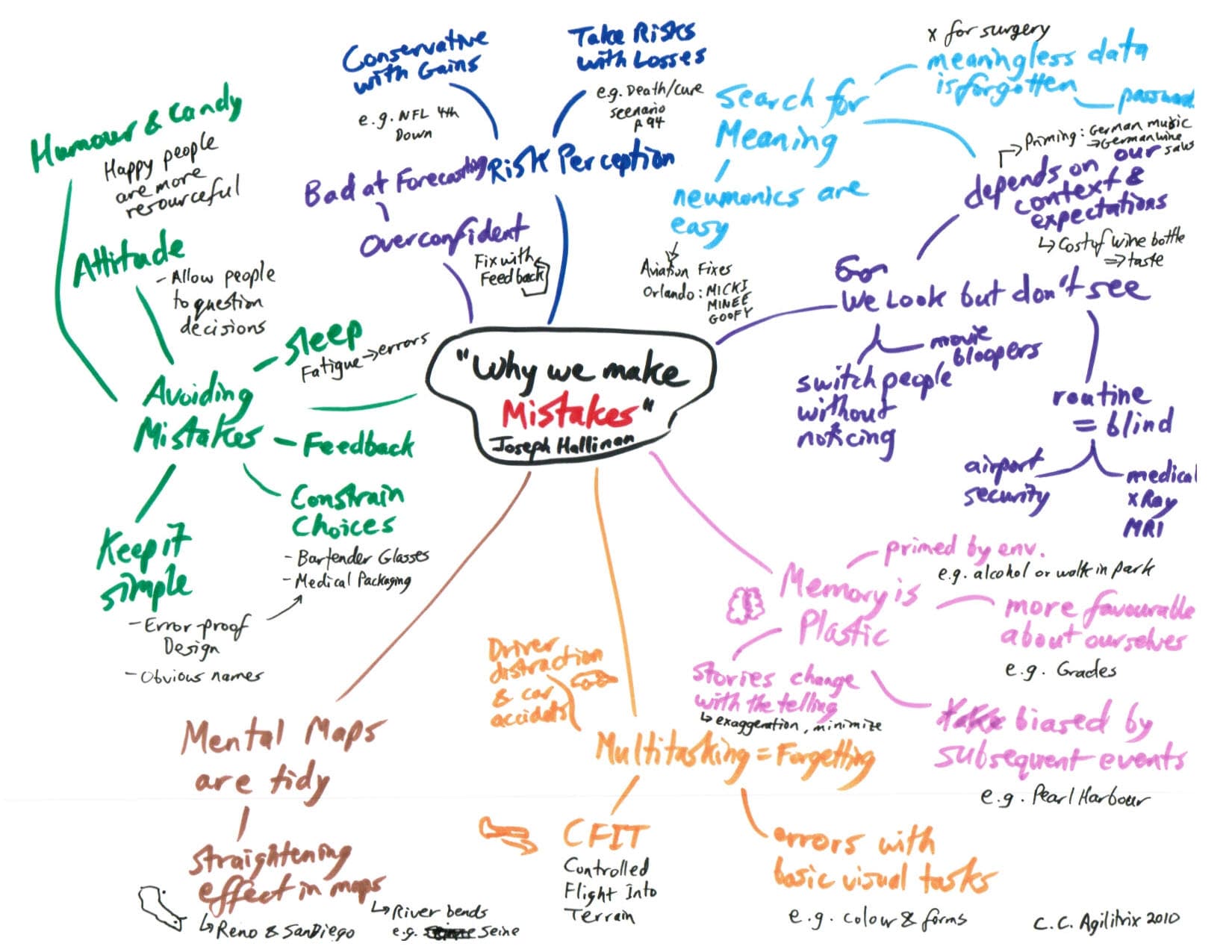
Conclusion.  Hallinan recommends that we give close attention to those things we have opted not to choose, this is a good exercise to realize the why of our mistakes and we can learn from them. He also invites the readers to think a bit negatively sometimes, not always positive. To allow ourselves to learn even from those who are not such experts as we think, since their non-expertize will allow them to see errors that the experts have overlooked. He also recommends people to sleep well, since he claims that sleepiness is one of the main causes of error. And to be happy with what we have, learn how to love what we currently have because if we keep thinking about what we could have we will be unhappy.
Source

Discussion: This book discusses ideas that were introduced in the Norman books, such as claiming that the world we are living in is pushing us to make mistakes for example when we have to learn so many PINs and passwords. He also claims we can only remember a few things at a time, just like Norman explained. The concepts of constraints and affordances are later discussed in this chapter, and it was surprising to see the similarities in the explanations about these concepts from both Hallinan and Norman.  

Hallinan provides concepts and factors that affect individual's choices, factors that we cannot see. For example the meaning we give to things is one of the most efficient things to remember them. Also, he explains how things that we do or believe unconsciously, affect our acts. idents was really interesting. The fact that it is intended to do good but ends up doing the opposite can take us back to design concepts. He even mentioned some things that could be done to the design in order to decrease distraction, but the problem is that these should be there since the beginning in order to avoid these horrible deadly accidents.

It was interesting to read about examples that one way or another I have thought about before and now, I can read about the logic or explanations behind them, and why we behave as we do. It is also interesting to see how majority of these scenarios have been researched and experiments have been performed in similar situations.

One of the discussions that most called my attention and that was somehow linking a few of the chapters was overconfidence. It's amazing how being overconfident can be both, good and bad, depending on the situation you are in.

Sunday, April 17, 2011

Book Reading #50: Why We Make Mistakes

Why We Make Mistakes
Joseph T. Hallinan

Summary: 
Chapter 12: We Don't Constrain Ourselves. In this chapter, Hallinan discusses concepts such as constraints and affordances, and how employing these two concepts could avoid many of the "human errors" we make. Some of the examples he gives include that of the deaths of many patients when given the wrong prescription or the wrong amount of doses. How these errors could be avoided if we give meaningful names and descriptions to things, such as the names of the points in the sky given by the FAA. Misattributing the error to the correct reason is one of the reasons why we haven't been able to prevent us from making so many errors. Through out the chapter, Hallinan discusses actions that the FAA has taken in order to reduce the amount of human error, something medical societies have not. 

Chapter 13: The Grass Does Look Greener. This chapter was dedicated to discussing how individuals are not very accurate at predicting how happy they and other will feel as a consequence of an event. Some of the examples he used were about moving to California, and how everybody thinks they will be happier if they lived there, but in fact, there are many people who decide to move from there after trying to live there for a couple of years. One of the causes he discussed is that of having hope of things becoming better. If there is hope that a situation can become better, individuals are not adapting to the current situation, thus not living it to the best of their abilities.

Conclusion. This is a summary chapter of the complete book. Hallinan reviews and summarizes the main ideas of the book, and provides readers with some of the most important examples he had given. He recommends that we give close attention to those things we have opted not to choose, this is a good exercise to realize the why of our mistakes and we can learn from them. He also invites the readers to think a bit negatively sometimes, not always positive. To allow ourselves to learn even from those who are not such experts as we think, since their non-expertize will allow them to see errors that the experts have overlooked. He also recommends people to sleep well, since he claims that sleepiness is one of the main causes of error. And to be happy with what we have, learn how to love what we currently have because if we keep thinking about what we could have we will be unhappy.
Discussion: The ideas from chapter twelve were very easy to understand since they were concepts we learned from the Norman readings. I think it is really interesting to see how these concepts are applied throughout many books, and how relevant these ideas are in order to avoid error. 

In chapter thirteen, the idea of high expectations leading us to be unhappy is something I had encountered before. I think this is linked to the idea of having so many choices that after we have picked one, we stress ourselves thinking maybe we did the wrong decision and we would be better off if we had made a different decision in the first place.

I really enjoyed reading the conclusion of this book. Even though he summarizes the previous chapters and key ideas, he also gives advice to the reader regarding how to live a better life with a reduced amount of errors.

Book Reading #49: Why We Make Mistakes

Why We Make Mistakes
Joseph T. Hallinan

Summary: 
Chapter 10: We All Think We Are Above Average. Hallinan describes overconfidence to be one of the main reasons why people believe they are better at something than they really are. He claims overconfidence is observed in almost everyone, except those who are depressed. He mentions various examples of how businesses have learned how to take advantages of this overconfidence, and individuals end up loosing money thinking they will do better than others, for example going more often to the gym, paying off credit cards before interest rates get higher, and thinking we can diet better than the average person. The term for this concept is calibration, we are poorly calibrated thinking we are better than we in fact are. He also discusses the fact that we think the more information we obtain the better equipped we will be, which actually leads to information overflow.

Chapter 11: We'd Rather Wing It. Practice is what makes experts. Hallinan states that almost 10 years of serious practice are required for someone to become an expert at something. This fact is attributed to experts practicing creating a library in their minds, where they use patter recognition to allow them to anticipate evens and learn how to respond quickly. He then discussed cognitive maps, and how non experts rather try doing things themselves without reading manual, just guided by how they think work, but unfortunately this leads them to make many errors. He also discussed how people become accustomed to a way of doing things, that they ignore new and simpler ways to getting things done.

Discussion: In chapter ten, Hallinan discusses how we think we are better than average, and how we can do better than that, however, I think majority of us are actually in than average standing. I think this belief comes from the idea of being always positive, but what if we were not always positive, what if we were always thinking negatively? If we were, then we would never strive to be better, to become better individuals than we currently are. 

In chapter eleven, one of the ideas that called my attention the most was towards the end of the chapter, and it was about becoming used to do things one way, that we become blinded to see what other new ways there are to do things better. Reading about this reminded me of the discussion we had in class regarding teaching individuals to use shortcuts in a computer. I think this is some how contradictory with the discussion in chapter ten, and the idea of staying positive and trying to do better.

Wednesday, April 13, 2011

Paper Reading #21: Epistemology-based Social Search

Comments:
Comment 2

Reference Information
Title: Supporting Exploratory Information Seeking by Epistemology-based Social Search
Authors: Y. Mao, H. Shen, C. Sun
Presentation: (Conference Paper) IUI'10, Febrary 7-10, 2010, Hong Kong, China

Summary: In this paper the authors present a system called Baijia, an epistemology-based social search solution for the problem of finding the proper keywords and evaluating results in search engines. The system reuses and refines previous successful searches to provide users with successful, accurate and desired information.

The system uses packages of information derived from a number of resources such as search processes, queries, results, ranking, annotation, comments, etc, in order to provide the user with a successful search process even if he entered keywords that are not as relevant or are vague. Basically, the system has an epistemology repository, and every time a user adds a query, it is added, and can then be linked to previous epistemology records, comments, web pages, etc. all with the purpose of presenting the user information about previous searches.

Even though they have not yet performed user studies, their experimental evaluations have showed that such a system outperforms conventional search systems.

Discussion: Even though I think this may be a good idea to improve search results, I don't think the paper did a great job in explaining the system. I suppose such an application can be useful for people who are trying to find out about something, but they don't really have the words to describe it. Also, if users have the capability of commenting on the results of the search, that can allow users to warn each other about certain websites that are not useful.


Monday, April 11, 2011

Ethnography Results, Week 8

Paola Garza
April 7th, 2011 (Thursday)
9:00 am-11:00 am

·    
·         Reading: 1
·         Computers:  ( M 3 P 2 )
·         Headphones on: 2
·         Studying (with studying materials w/wo computers): 4
·         Visiting: 2
·         Alone  (I could see from where I was sitting, including me): 6
·         Two or more  (I could see from where I was sitting):   7 groups
·         Patrons that seem not be students (if any): 12
·         People that came in and left while I was here: 2
·         People that were before I came in and left while I was here:  4
·   
·         Guys: 5
·         Girls: 13

My Location:
Today I’m sitting in a very particular location, and under very particular circumstances. I had never been here during the week at a morning time. I’m sitting in one of the couches that were recently set in the space right to the door. I have a view of the counter. I was able to observe more drive-thru activity, as well as well as more frequent purchases. There was actually a line… During the past weeks I would come at times where even though it was crowded, there wasn’t a long line waiting to order.

The Customers:
As I mentioned above, a really different crowd from what I’m used to.

There were two men sitting in the middle room, dressed with suits. Businessmen, maybe. There was also an old men who had some coffee and pastries, and was reading the news paper. Then he went back to the counter to buy some more coffee. He reminded me of a man  I saw on a Sunday morning who was a drinking some coffee but instead of reading the newspaper he had a computer on his lap. I figured he was reading some news online.

There was also a young man who seemed not to be a student because of the way he was dressed, but he was reading a book and taking notes on a computer.Other students, majority girls, also went up to the counter to buy some breakfast and came back to the tables to do some studying.

Majority of the students that were coming in at this time were buying some breakfast, including me for the first time, and started studying right away.

At this time in the morning, I observed more activity in the drive-thru. Even though it was really quiet, the place wasn't empty at all.

Sunday, April 10, 2011

Book Reading #47: Why We Make Mistakes

Why We Make Mistakes
Joseph T. Hallinan

Summary: 
Chapter 8: We Like Things Tidy. In this chapter, Hallinan discusses the idea that people like to straighten things up, make them simple or even rationalize them in order to understand them better. Some of the examples he gave included those of straightening streets in New York, the Seine river in Paris; simplifying or shortening maps, stories that we re-tell and even the national anthem. Hallinan explains we don't do it in purpose, in fact we truly believe what we do.

Chapter 9: Men Shoot First. Throughout the chapter, Hallinan gives different examples of actions where men and women behave differently. In majority of the cases, men tend to do better than women. Hallinan attributes this to men being overconfident. This overconfidence is then transformed into taking risks for example; men are more likely to take risks than women. One of the roots of this difference is attributed to the early years of men and women; men are given more freedom to 'tinker' (explore) around than women.

Discussion:
This is something I really hadn't though about. After I read part of chapter eight, I went to a lecture series and the program for the even had the map of the American continent drawn on it. I looked at it, and realized that it was really simplified. I am not sure what the reason for this was, but it made me think back about the chapter. Do we really simplify things just to understand them better, or do we do it to make things easier?

Chapter nine made me think back at my childhood growing up in a small town in Mexico. Ever since I was eight or nine my mom would give me permission to go to my friends' houses which were around 4 or 5 blocks away. I remember just taking different routes to their homes, not sure if its because I was lost or not! I found this chapter really interesting given I'm a woman in Computer Science. It just made me thing about my level of confidence and if it was in fact affected by my childhood.
 

Thursday, April 7, 2011

Things That Make Us Smart

Things That Make Us Smart
Donald. A. Norman

Summary:
Chapter 1: A Human-Centered Technology. Norman opens the chapter by stating that technology not only has positive effects, but negatives as well. The main idea of this first chapter is that technology has been developed with a focus apart from humans. It has not been design to accommodate humans, but humans must adapt to technology. He also introduces the two types of cognition relevant to his studies, experiential and reflective.

Chapter 2: Experiencing the World. In this chapter, Norman goes more in depth in describing experiential and reflective cognition. In summary, they differ in the way information is processed. Norman describes the experiential mode as of data-driven processing. It is automatic, it is our reactions to events. The reflective mode in the other hand is the one concerning concepts, planning and evaluation. He also describes three kinds of learning: accretion (accumulation of facts). tuning (practice to become experts), and  restructuring (not losing practice).
 
Chapter 3: The Power of Representation. In this chapter Norm talks about how we represent the world utilizing cognitive artifacts. He defines the Represented World (Real World), and the Representing World (symbols which represent the represented world). He also discuses various ways in which data can be represented, and explains how some lead to experiential cognition while others to reflective cognition.
Chapter 4: Fitting the Artifact to the Person. Norman introduces the concepts of surface and internal representation. Surface representation is when what we see is all there is to it (a book), an internal representation has more in the background that we cannot see (calculator). He also discusses how representations must fit the task or the person, depending in the situation. He also brings back the concept of affordances in terms of technology. He claims technology also has affordances.
 
Discussion:  Overall I like the way Norman is presenting the concepts of the book, however I think the examples are too long. Even though the chapters are long, they are still interesting to read. I really enjoyed the first chapter since I think it deals more directly with CHI, and how our designs should be of positive results for users. On the third chapter, the discussion about representing numbers was really interesting. It made me remember my days of school when I had to learn Roman numerals. I think it is really interesting how each representation allows you to do different things easier than the others. For chapter four, the discussion about affordances in technology was the best part in my opinion. I like how Norman bring this concepts back from The Design of Every Day Things, and includes it in this chapter.